Approximations in calculations is done by rounding each of the numbers in such a way that the calculation becomes relatively straight forward.
The symbol ‘≈’means ‘is approximately equal to’
Example
Estimate the value of 55×252 by rounding each number to one significant figure
Solution
55×252
Hence in this question we have to first round 55 to 60 and then round 252 to 300. ( Any problem with approximation and rounding of number CLICK HERE Approximation of numbers. to learn more about how to approximate and round off numbers.
Hence we obtain:
≈60×300
=1800
Exercise.
Estimate each of the following by rounding each number to one significant figure.
a) 288.7×7.8
Solution
288.7×7.8
≈300×8
=2400
b) 142.75×9.56
Solution
142.75×9.56
≈ 100×10
=1000
c)(9.9×285)/(18.7×3.2)
Solution
(9.9×285)/(18.7×3.2)
≈(10×300)/(20×3)
=3000/60
=50
Try these
d) 494.27÷5.05
e) (310.33×2.68)/(316.39×0.82)
f) (173.64× 10.6)/(64.44× 5.58)
To SIGN UP and get started in crypto on BINANCE CLICK HERE
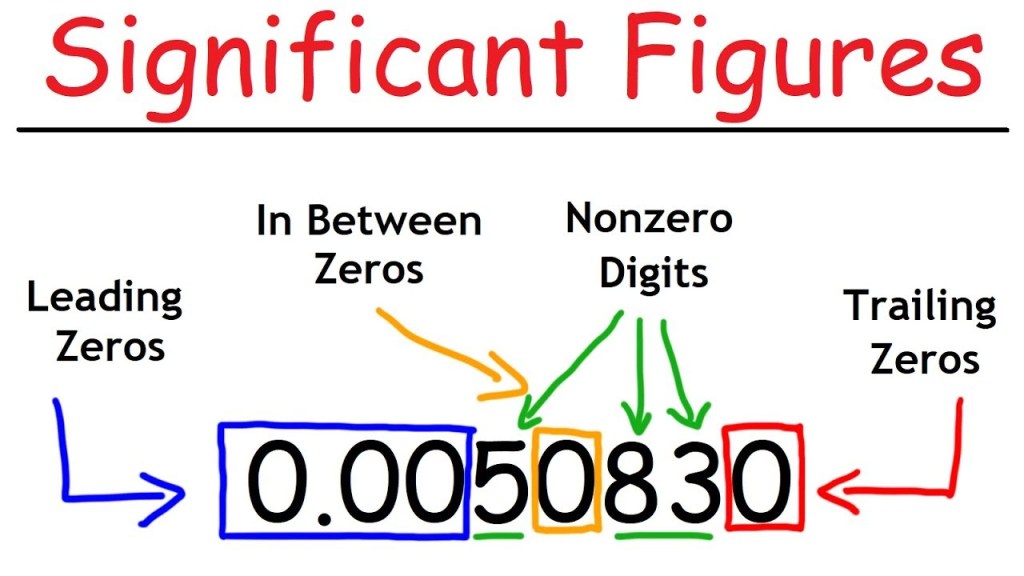
-Significant figures are all non-zero digits, example 7436, the 7, 4, 3 and 6 are non-zero digits hence are significant figures.
-A zero (or zero) between non-zero digits is (are) significant figures. Example 7046 and 4003, the zero between non-zero digits is (are) Significant figures.
Example
5007=5000(to 1 significant figure)
Explanation.
The first significant figure in 5007 is 5 and the next number to the right of 5 is 0 which is below five, hence the 5 remains the same and we obtain a new number 5000.
5007=5000(to 2 significant figures)
Explanation.
The second significant figure 5007 is 0 and the next number to the right of 0 is 0 which is below five, hence the 0 remains the same and we obtain a new number 5000.
5007=5010(to 3 significant figures)
Explanation.
The third significant figure in 5007 is 0 and the next number to the right of 0 is 7 which is above five, hence we round up 0 to 1 and we obtain a new number 5010.
Any problems with approximation and rounding off of numbers CLICK HERE: Approximation of numbers. to learn how to approximate and and round off numbers.
5347=5000(to 1 significant figure)
Explanation.
The first significant figure in 5347 is 5 and the next number to the right of 5 is 3 which is below five, hence the 5 remains and we obtain a new number 5000.
5347=5300(to 2 significant figures)
Explanation.
The second significant figure in 5347 is 3 and the next number to the right of 3 is 4 which is below five, hence the 3 remains and we obtain a new number 5300.
5347=5350(to 3 significant figures)
Explanation.
The third significant figure in 5347 is 4 and the next number to the right of 4 is 7 which is above five, hence we round up 4 to 5 and obtain a new number 5350.
Example
Express 4033 correct to.
a) 1 significant figure.
ANS: To 1 significant figure (=4000)
b) 2 significant figures
ANS: To 2 significant figures (=4000)
c) 3 significant figures
ANS: To 3 significant figures (=4030)
Try these
Express 789 correct to
a) 1 significant figure.
b) 2 significant figures.
Significant figures for decimal numbers.
-In a decimal, zeros before the first non-zero digit are not significant.
Example: 0.00503
The first three zeros on the left side are not significant figures.
Exercise:
1. Round the following numbers to one significant figure.
a) 0.0672
ANS: To one significant figure (=0.0700)
Explanation.
The first significant figure in 0.0672 is 6 and the next number to the right of 6 is 7 which is above 5, hence we round up 6 to 7 and obtain a new number 0.0700.
b) 0.349
ANS: To one significant figure (=0.300)
Explanation.
The first significant figure in 0.349 is 3 and the next number to the right of 3 is 4 which is below 5, hence the 3 remains the same and obtain a new number 0.300.
c) 0.00055
ANS: To one significantfigure (=0.0006)
Explanation.
The first significant figure in 0.00055 is 5 and the next number to the right of 5 is 5 which is equal to 5, hence we round up 5 to 6 and obtain a new number 0.00060
Try These
d) 0.0197
e) 0.000798
2. Round the following numbers to two significant figures.
a) 674.81
ANS: To two significant figure (=670.00)
Explanation.
The second significant figure in 674.81 is 7 and the next number to the right of 7 is 4 which is below 5, hence the 7 remains the same and we obtain a new number 670.00
b) 974.008
ANS: To two significant figures (=970.00)
Explanation.
The second significant figure in 974.008 is 7 and the next number to the right of 7 is 4 which is below 5, hence the 7 remains the same and we obtain a new number 970.00
c) 0.003753
ANS: To two significant figures (=0.0038)
Explanation.
The second significant figure in 0.003753 is 7 and the next number to the right of 7 is 5 which is equal to 5, hence we round up 7 to 8 and obtain a new number 0.0038.
Try these
d) 0.0001792
e) 0.5635
3. Round the following to three significant figures.
a) 80.569
ANS: To three significant figures (=80.600)
Explanation.
The third significant figure in 80.569 is 5 and the next number to the right of 5 is 6 which is above 5, hence we round up 5 to 6 and obtain a new number 80.600
b) 0.08521
ANS: To three significant figures (=0.08520)
Explanation.
The third significant figure in 0.08521 is 2 and the next number to the right of 2 is 1 which is below 5, hence the 2 remains the same and we obtain a new number 0.08520
c) 0.00041769
ANS: To three significant figures (=0.00041800)
Explanation.
The third significant figure in 0.00041769 is 7 and the next number to the right of 7 is 6 which is above 5, hence we round up 7 to 8 and obtain a new number 0.00041800.
Try these
d) 146.83
e) 0.10653 4.
4.The density of Hydrogen gas is 0.0899kg/m^3. Round this density to one significant figure.
To SIGN UP and get started in crypto on BINANCE CLICK HERE
A number is a mathematical value that helps to count or measure objects.
The system in which these numbers are expressed and represented is called number systems.
Using numbers we can perform different Mathematical calculations.
Base ten number systems.
Base ten number system is a number system that uses ten different digits to write numbers. These digits are 0,1,2,3,4,5,6,7,8,9.
Base 10 number system is widely used on most parts of Math. It is often the first way kids learn how to count.
CLASSIFICATION OF NUMBERS.
Numbers can be classified in many different ways. Below is a description of some of the more common types of numbers.
1)Natural numbers.
These are sometimes called the counting numbers. Natural numbers are denoted by N.
Natural numbers are used in counting or ordering. Natural numbers start from 1 and end at infinity.
The set of natural numbers N= {1, 2,3,4,5, etc.}
Because they are used for counting they do not include zero or negative numbers.
2)Whole numbers.
Whole numbers are numbers that do not include fractions, decimals and negative numbers.
Natural numbers along with the number zero (0) are referred to as whole numbers.
Whole numbers are denoted by the symbol W.
W= {0, 1, 2, 3, etc.}
3)Integers.
An integer is a whole number that can be positive, negative or zero with no decimal or fractional part.
Integers are denoted by Z.
The set of integers Z= {_, _,-3,-2,-1, 0-1, 2, 3, _, _}.
Integers are therefore an extension of whole numbers and natural numbers (N). Every natural number and or whole number is an integer.
4)Mixed numbers.
A mixed number is a whole number combined with a fraction.
Example: 3 1/4
Where 3 is a whole number and 1/4 is a fraction.
5)Rational numbers.
Rational numbers are numbers which can be written as a fraction whose denominator is not zero. A rational number can always be written exactly in the form of a/b where a and b are whole numbers.
All terminating and recurring decimals are rational numbers as they can also be written as fractions.
Example: 0.5= 1/2
0.2= 1/5
7= 7/1
1.5= 150/100
1 1/2 = 3/2
6)Irrational numbers.
Irrational numbers are numbers which cannot be expressed as a fraction.
Irrational numbers cannot be written in the form of a/b.
Example: √2, √5, π etc.
Irrational numbers do not recur or repeat in a pattern. Example √2=1.41421356……
The digits in this number do not recur or repeat in a pattern.
Another example is π (pi). It is the ratio of the circumference of a circle to the length of its diameter. Although it is often rounded to 3.142, the digits continue indefinitely never repeating themselves in any particular pattern.
7)Real numbers.
The set of rational and irrational numbers together form the set of REAL NUMBERS.
Real numbers are denoted by R.
8)Prime numbers.
A prime number is a number whose factors are 1 and itself only.
A prime number is divisible only by itself and by one.
(Note that 1 is not a prime number)
Examples of prime numbers= {2, 3, 5, 7, 11, 13, 17, etc.}
9)Square numbers.
When an integer (whole number) is multiplied by itself, the result is a Square number. It is the result of multiplying a number by itself.
Example:
a) The number 4 can be written as 2×2 or 2^2.
b) The number 9 can be written as 3×3 or 3^2.
c) The number 16 can be written as 4×4 or 4^2.
In the example above 4,9,16 are Square numbers.
10)Cube numbers.
When a number is multiplied by itself and then by itself again, the result is a Cube number.
It is the result of multiplying a number by itself three times.
Example:
a) The number 8 can be written as 2×2×2 or 2^3.
b) The number 27 can be written as 3×3×3 or 3^3.
c) The number 64 can be written as 4×4×4 or 4^3.
In the examples above 8, 27, 64 are Cube numbers.
To SIGN UP and get started in crypto on BINANCE CLICK HERE
Decimals are numbers, which has a whole number and the fractional part separated by a decimal point.
The dot present between the whole number and the fractional part is called the decimal point. For example, 78.965 is a decimal number.
Here, 78 is a whole number part and 965 is the fractional part.
‘ . ‘ is the decimal point.
Types of Decimal Numbers
Types of decimal numbers includes:
1) Recurring Decimal Numbers (Repeating or Non-Terminating Decimals)
Example.
5.55 (Finite)
5.333333333….. (Infinite)
2) Non-Recurring Decimal Numbers (Non Repeating or Terminating Decimals)
Example.
5.325(Finite)
5.23456…. (Infinite)
Place values of decimal numbers.
When we write numbers, the position (or “place”) of each digit is important.
The first digit to the right of the decimal point indicates the number of tenths.
For example, the decimal 0.56 the first digit to the right of the decimal point which is 5 indicates the number of tenths.
The second digit to the right of the decimal point which is 6 indicates the number of hundredths.
You can write decimals with many places to the right of the decimal point. For example, this is a representation of the decimal number 324.156789 which is equal to
324 156 789/1 000 000, with the place values named:
3-Hundreds
2-Tens
4-Ones
1-Tenths
5-Hundredths
6-Thousandths
7-Ten thousandths
8-Hundred thousandths
9-Millionths
OPERATIONS ON DECIMALS
Addition of decimals.
Example
Evaluate
a) 7.6+1.9
Solution
7.6+1.9=9.5
b) 7.004+0.368
Solution
7.004+0.368=7.372
c) 4.2+42
Solution
4.2+42=46.2
Try these
d) 20.4+20.399
e) 0.06+0.006
Subtraction of decimals.
Example
Evaluate
a) 3.84-2.62
Solution
3.84-2.62=1.22
b) 4.61-3
Solution
4.61-3=1.61
c) 25-7.8
Solution
25-7.8=17.2
Try these
d) 11.4-9.73
e) 0.06-0.006
Multiplication of decimals.
You multiply decimals just like you would normal whole numbers. The important thing in multiplying decimals is understanding how and when to move the decimal point so you get the correct answer.
Example
78.12×0.7
Remember place value. That means 78 and 12 hundredths multiplied by 0.7, or seven-tenths.
In solving the problem, pretend (for just a moment) that the decimal point isn’t there. That would give you this equation:
7812×7
NOTE: The zero 0 is not needed since it doesn’t add anything to the equation. If we solve this equation, we get:
7812
× 7
The answer is 54684.
The next step we have to figure out where to place the decimal. Here’s how it’s done.
Go back to the original equation and count how many numbers are behind each decimal point. In this case, there are three. Two here (78.12) and one here (0.7).
Now that we know there are three numbers behind the decimals, we go back to our answer and place the decimal three places from the last number. So the first answer we got was 54,684. But remember, we have to move our decimal point three places to the left because we had 3 places behind our decimal points here. So when we do that, our decimal point ends up right after our 54.
Hence our final answer is 54.684.
EXERCISE
Evaluate
a) 2.6×0.6
Solution
2.6×0.6=1.56
b) (0.01) ^2
Solution
(0.01) ^2=0.01×0.01
=0.0001
c) 0.36×1000
Solution
0.36×1000=360
Try these
d) 0.1×0.2
e) 11.4×9.73
Division of decimals
For dividing decimal numbers, there are two (2) cases to consider- one in which we need to divide decimals by a whole number, and the other in which we divide decimals by decimals.
1st Case.
Dividing decimals by whole numbers.
Dividing decimals by whole numbers is similar to normal division. Here, the dividend is a decimal number and the divisor is a whole number, so the decimal point in the quotient will be placed according to the decimal point of the dividend.
Example:
Evaluate 4.5÷9
Solution
4.5÷9
Here the dividend is a decimal number 4.5 and the divisor is the whole number 9.
Hence dividing 4.5 by 9 we get the quotient 0.5.
So the quotient (result of division) obtained has one decimal place just like the dividend which also has one decimal place.
2nd Case.
Dividing decimals by decimals.
When we divide decimals by decimals we have to convert the divisor to a whole number by moving the decimal point to the left. Then, we carry the dividend’s decimal point up to the same number of places to the left and divide the resultant numbers in the usual way as we perform in regular long division.
Example.
0.49÷ 0.7
Here, the Divisor = 0.7
And Dividend = 0.49
Change the divisor 0.7 to a whole number by moving the decimal point 1 place to the left by multiplying 0.7 by 10. Then move the decimal point in the dividend the same, 1 place to the left by multiplying by 10 also.
0.49×10÷ 0.7×10 = 4.9÷ 7
Now, divide the decimal number 4.9 by the whole number, i.e. 7.
Thus the quotient is 0.7
EXERCISE
a) 7.004÷0.368
Solution
(7.004×1000)/(0.368×1000)
=7004/368
=19.0326
b) 3.6÷0.2
Solution
3.6÷0.2
=(3.6×10)/(0.2×10)
=36/2
=18
c) 0.007÷4
Solution
0.007/4=0.00175
Try these
d) 1100÷5.5
e) (0.3) ^2÷100
To SIGN UP and get started in crypto on BINANCE CLICK HERE
Numbers can be approximated (or rounded) to make them easier to work with. A number can be approximated by rounding. Approximation or rounding creates a new number that is similar but not exactly equal to the original number.
Rounding numbers to the nearest 10,100,1000.
But before rounding a number we need to know the position of each digit in a number or the place value of each digit in a number.
The table below represent the position of each digit in a number to the left of a decimal point which is shown at the right end column box.
Ten millions
Millions
Hundred thousands
Ten thousands
Thousands
Hundreds
Tens
Ones
Decimal point
The table below represent the position of each digit in a number to the right of a decimal point which is shown at the left end column box.
Decimal point
Tenths
Hundredths
Thousandths
Ten thousandths
Hundred thousandths
Millionths
Ten millionths
For example, a number like 6478.7 it has the following place value for its digits.
6
4
7
8
.
7
Thousands
Hundreds
Tens
Ones
Decimal point
Tenths
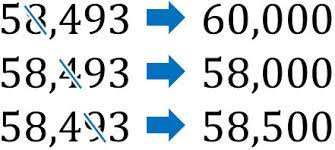
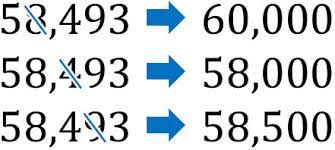
Hence in rounding a number you look at the number one place to the right of the level that you are rounding to and see whether it is closer to 0 or 10.
This means that if you’ve been asked to round to the nearest 10, you look at the ones. If you are rounding to three decimal places, you look at the ten thousandths (the fourth number to the right of the decimal point) and so on. If that number is 5 or over, you round up to the next number, and if it is 4 or under, the number remains the same.
For example a number 6478.7 could be rounded to:
-To the nearest whole number (=6479.0)
Explanation.
In this question we are rounding 6478.7 to the whole number (ones) place value which has number 8 and the next number to the right is 7 which is above five, hence we round up 8 to 9 and hence obtain a new number 6479.0
-To the nearest ten (=6480.0)
Explanation.
In this question we are rounding 6478.7 to the tens place value which has number 7 and the next number to the right is 8 which is above five, hence we round up 7 to 8 and hence obtain a new number 6480.0
-To the nearest hundred (=6500.0)
Explanation.
In this question we are rounding 6478.7 to the hundreds place value which has number 4 and the next number to the right is 7 which is above five, hence we round up 4 to 5 and hence obtain a new number 6500.0
-To the nearest thousand (=6000.0)
Explanation.
In this question we are rounding 6478.7 to the thousands place value which has number 6 and the next number to the right is 4 which is below five, hence the 6 remain the same and hence obtain a new number 6000.0
Try this
At its closest, Jupiter is about 390682810 miles from Earth. Write this distance to the nearest million miles.
APPROXIMATIONS OR ROUNDING OF DECIMAL NUMBERS.
For decimal numbers you can round a decimal number to different numbers of decimal places.
For example a number like 9.7362 could be rounded to:
-To one decimal place (=9.7000)
Explanation.
In this question we are rounding 9.7362 to one decimal place which has number 7 and the next number to the right is 3 which is below five, hence the 7 remains and we obtain a new number 9.7000
-To two decimal place (=9.7400)
Explanation.
In this question we are rounding 9.7362 to two decimal places which has number 3 and the next number to the right is 6 which is above five, hence we round the 3 to 4 and we obtain a new number 9.7400.
-To three decimal place (=9.7360)
Explanation.
In this question we are rounding 9.7362 to three decimal places which has number 6 and the next number to the right is 2 which is below five, hence the 6 remains and we obtain a new number 9.7360
Try this
The density of Hydrogen gas is 0.0899kg/m^3. Round this density to two decimal place.
To SIGN UP and get started in crypto on BINANCE CLICK HERE


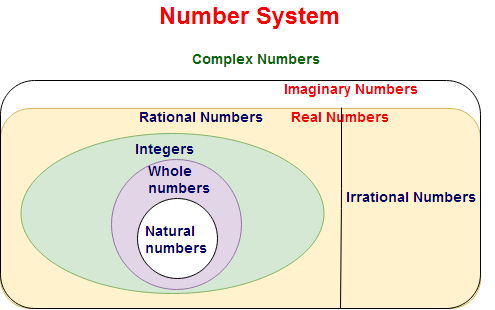
 and natural numbers (N). Every natural number and or whole number is an integer.