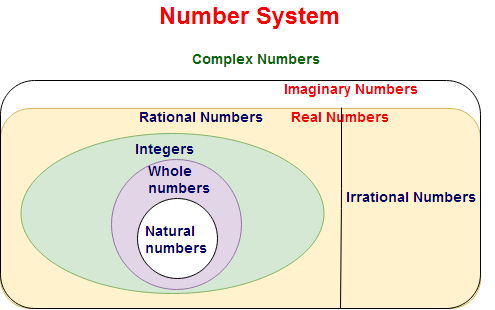
NUMBER SYSTEMS DEFINITION.
A number is a mathematical value that helps to count or measure objects.
The system in which these numbers are expressed and represented is called number systems.
Using numbers we can perform different Mathematical calculations.
Base ten number systems.
Base ten number system is a number system that uses ten different digits to write numbers. These digits are 0,1,2,3,4,5,6,7,8,9.
Base 10 number system is widely used on most parts of Math. It is often the first way kids learn how to count.
CLASSIFICATION OF NUMBERS.
Numbers can be classified in many different ways. Below is a description of some of the more common types of numbers.
1)Natural numbers.
These are sometimes called the counting numbers. Natural numbers are denoted by N.
Natural numbers are used in counting or ordering. Natural numbers start from 1 and end at infinity.
The set of natural numbers N= {1, 2,3,4,5, etc.}
Because they are used for counting they do not include zero or negative numbers.
2)Whole numbers.
Whole numbers are numbers that do not include fractions, decimals and negative numbers.
Natural numbers along with the number zero (0) are referred to as whole numbers.
Whole numbers are denoted by the symbol W.
W= {0, 1, 2, 3, etc.}
3)Integers.
An integer is a whole number that can be positive, negative or zero with no decimal or fractional part.
Integers are denoted by Z.
The set of integers Z= {_, _,-3,-2,-1, 0-1, 2, 3, _, _}.
Integers are therefore an extension of whole numbers  and natural numbers (N). Every natural number and or whole number is an integer.
4)Mixed numbers.
A mixed number is a whole number combined with a fraction.
Example: 3 1/4
Where 3 is a whole number and 1/4 is a fraction.
5)Rational numbers.
Rational numbers are numbers which can be written as a fraction whose denominator is not zero. A rational number can always be written exactly in the form of a/b where a and b are whole numbers.
All terminating and recurring decimals are rational numbers as they can also be written as fractions.
Example: 0.5= 1/2
0.2= 1/5
7= 7/1
1.5= 150/100
1 1/2 = 3/2
6)Irrational numbers.
Irrational numbers are numbers which cannot be expressed as a fraction.
Irrational numbers cannot be written in the form of a/b.
Example: √2, √5, π etc.
Irrational numbers do not recur or repeat in a pattern. Example √2=1.41421356……
The digits in this number do not recur or repeat in a pattern.
Another example is π (pi). It is the ratio of the circumference of a circle to the length of its diameter. Although it is often rounded to 3.142, the digits continue indefinitely never repeating themselves in any particular pattern.
7)Real numbers.
The set of rational and irrational numbers together form the set of REAL NUMBERS.
Real numbers are denoted by R.
8)Prime numbers.
A prime number is a number whose factors are 1 and itself only.
A prime number is divisible only by itself and by one.
(Note that 1 is not a prime number)
Examples of prime numbers= {2, 3, 5, 7, 11, 13, 17, etc.}
9)Square numbers.
When an integer (whole number) is multiplied by itself, the result is a Square number. It is the result of multiplying a number by itself.
Example:
a) The number 4 can be written as 2×2 or 2^2.
b) The number 9 can be written as 3×3 or 3^2.
c) The number 16 can be written as 4×4 or 4^2.
In the example above 4,9,16 are Square numbers.
10)Cube numbers.
When a number is multiplied by itself and then by itself again, the result is a Cube number.
It is the result of multiplying a number by itself three times.
Example:
a) The number 8 can be written as 2×2×2 or 2^3.
b) The number 27 can be written as 3×3×3 or 3^3.
c) The number 64 can be written as 4×4×4 or 4^3.
In the examples above 8, 27, 64 are Cube numbers.

To SIGN UP and get started in crypto on BINANCE CLICK HERE
OTHER RELATED TOPICS:

